What are your thoughts on A Step-by-Step Guide to Installing a Bathtub?

Setting up a bath tub isn't exactly rocket science, yet it does require solid plumbing, woodworking, and also in some cases, tiling abilities. Changing an old bathtub with a new one is likewise a reasonably difficult job. If the old bathtub is conveniently accessible, the job can move rapidly; if you have to open a wall to eliminate the old bathtub and position the brand-new bathtub, the task is a lot harder. In either instance, the project is within a home handyman's skills, although you will certainly require an assistant to move out the old tub as well as embeded in the brand-new one. See to it you have qualified yourself for the task as well as are comfortable trying it. Rather than hiring a professional to take control of a halfway-completed job, it is far better to take into consideration employing one before you begin. Chances are you may need an expert plumber to make tube links.
This post will certainly aid you mount a brand-new bath tub in your washroom if you have actually currently acquired a brand-new bathtub and also do not require to alter the arrangement of your previous water supply pipes.
Your devices and also product list need to consist of the following:
Removing Old Taps
If you need to replace old taps with brand-new ones as a part of your installment, after that the first thing you must do is detach the supply of water. After doing so, switch on the taps to drain any type of water staying in the system. The process of removing the existing faucets can be fairly bothersome because of the restricted access that is frequently the case.
Make use of a container wrench (crowsfoot spanner) or a faucet tool to undo the nut that attaches the supply pipelines to the faucets. Have a fabric ready for the remaining water that will certainly originate from the pipes. As soon as the supply pipelines have actually been removed, use the very same tool to loosen up the nut that holds the taps onto the bath/basin. You will certainly require to stop the solitary taps from transforming during this process. As soon as the faucets have actually been removed, the holes in the bath/basin will certainly need to be cleaned up of any old securing substance.
Before going on to fit the new taps, contrast the pipe links on the old faucets to the brand-new taps. If the old faucets are longer than the brand-new taps, after that a shank adapter is required for the new faucets to fit.
Fitting New Touches
If the tails of the brand-new taps are plastic, after that you will require a plastic port to prevent damages to the thread. One end of the adapter fits on the plastic tail of the faucet and the various other end offers a connection to the existent supply pipelines.
If you need to fit a monobloc, after that you will call for decreasing couplers, which connects the 10mm pipeline of the monobloc to the basic 15mm supply pipeline.
Next, place the tap in the mounting hole in the bath/basin ensuring that the washing machines are in location between the faucet and the sink. Safeguard the tap in position with the producer given backnut. When the faucet is safely in place, the supply pipelines can be attached to the tails of the taps. The faucets can either be linked by utilizing corrugated copper piping or with typical faucet connectors. The previous type must be connected to the tap finishes first, tightening up just by hand. The supply pipes can later on be connected to the other end. Tighten up both ends with a spanner after both ends have actually been connected.
Setting up the Tub
Making use of the two wooden boards under its feet, position the bath tub in the called for placement. The wood boards are useful in uniformly spreading out the weight of the bathtub over the area of the boards rather than concentrating all the weight onto 4 small points.
The next objective is to make certain that the bathtub is leveled all round. This can be accomplished by checking the level and also adjusting the feet on the bathtub up until the level reviews level.
To set up faucets, fit the bottom of the furthest flexible faucet adapter to the suitable supply pipeline by making a compression join; after that do the same for the other faucet.
Switch on the water system and also check all joints and also new pipework for leaks as well as tighten them if needed. Load the bathtub and likewise examine the overflow electrical outlet and the typical electrical outlet for leaks.
Lastly, deal with the bath paneling as defined in the supplier's instruction manual. Tiling as well as securing around the bath tub needs to wait till the bathtub has been used a minimum of when as this will certainly resolve it right into its last setting.
Planning for the Installment
Firstly, the supporting frame supplied with the bathroom needs to be fitted (if called for) according to the producer's directions. Next, fit the taps or mixer to the tub. When suitable the tap block, it is very important to make certain that if the faucet features a plastic washing machine, it is fitted in between the bathroom as well as the faucets. On a plastic bathroom, it is likewise practical to fit a sustaining plate under the taps system to prevent strain on the bath tub.
Fit the adaptable faucet adapters to the bottom of the two taps making use of 2 nuts and also olives (occasionally provided with the bathtub). Fit the plug-hole electrical outlet by smearing mastic filler round the sink electrical outlet hole, and after that pass the outlet through the hole in the bath. Use the nut supplied by the supplier to fit the plug-hole. Check out the plug-hole electrical outlet for an inlet on the side for the overflow pipeline.
Next off, fit the end of the flexible overflow pipe to the overflow outlet. Afterwards, screw the pipeline to the overflow face which should be fitted inside the bathroom. Make certain you utilize all of the supplied washing machines.
Attach the trap to the bottom of the waste electrical outlet on the bath tub by winding the thread of the waste outlet with silicone mastic or PTFE tape, and screw on the catch to the electrical outlet. Link the bottom of the overflow tube in a comparable manner.The bathroom must now be ready to be suited its last position.
Tiling Around the Bathtub
In the location where the bathroom meets the tile, it is essential to secure the joins with a silicone rubber caulking. This is important as the fitting can move sufficient to split a stiff seal, causing the water to pass through the wall surface in between the bath and the tiling, bring about problems with dampness and also possible leaks to the ceiling listed below.
You can choose from a selection of coloured sealants to blend in your components and installations. They are offered in tubes and cartridges, and also are capable of sealing gaps approximately a width of 3mm (1/8 inch). If you have a larger space to fill, you can fill it with spins of soaked newspaper or soft rope. Keep in mind to always load the bathtub with water prior to sealing, to permit the motion experienced when the tub remains in use. The sealer can crack rather early if you do not think about this motion prior to sealing.
Conversely, ceramic coving or quadrant ceramic tiles can be made use of to edge the bathroom or shower tray. Plastic strips of coving, which are easy to use and reduce to dimension, are likewise conveniently offered on the market. It is suggested to fit the tiles making use of water-resistant or water resistant adhesive as well as cement.
A Step-by-Step Guide to Installing a Bathtub
Is your bathtub looking a bit dated lately? Believe it or not, installing a new one is a project you can do yourself. Whether your bathtub is broken or doesn’t fit in with your current bathroom’s design, you can fix it without having to hire a contractor or paying labour costs.
But, beyond saving money, there are other benefits of installing your own bathtub. When you do this project yourself, you can customise every step of the process. You can also make sure the finished product looks exactly the way you want it to.
This DIY project is quite involved, but by doing some research, preparing your bathroom and using the right equipment, it is definitely one you can take on. This guide will help you understand the technical procedures behind installing a new bathtub.
Remove the Existing Bathtub
To remove the old bathtub, you will need to turn the water supply off before you start any work. After you turn the water off, there will likely still be some water left in your plumbing system, which you can remove by turning on a faucet below the level of the bathtub. Once the water stops running, you are ready to start working.
The easiest way to remove the tub is to remove the faucet, handles and other piping and then pull the tub out from the wall. If this doesn’t work in your situation, you will need to remove part of the wall, remove the piping and then slide the tub out.
Choose the Right Bathtub
The ideal way to replace your bathtub is to find one that has the exact dimensions and has the drain and faucet on the same side as your old one. This way, it will fit in the same place and you won’t have to change the piping system in your bathroom. Choose a tub that matches your home’s decor and fits with the style of the bathroom.
Install the Plumbing and Ledger Board
You can purchase a tub drain kit at a hardware store which will have all the pieces you will need for your new tub’s plumbing. Follow the instructions that came with the kit to install the plumbing in the new tub and then take measurements to make sure the plumbing in the tub will align with the plumbing in your bathroom. If it doesn’t, now is the time to make necessary adjustments.
Some bathtubs need a ledger board that is installed on the wall behind the tub to help support it. If your new bathtub requires one, the directions that came with it will tell you how high it should be installed. If your old bathtub had a ledger board, and it is still in good condition, you can adjust its height to match the new bathtub.
Install the Bathtub
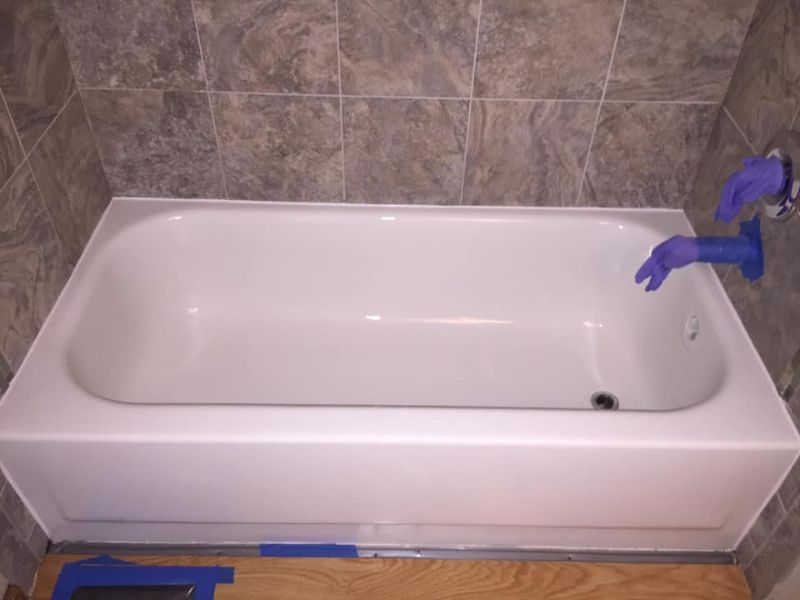
When the plumbing and ledger board are ready, you can install the new bathtub. Carefully lower it into the space, being careful not to damage the tub, wall, plumbing or ledger board. Since bathtubs are very heavy and you will need to line the tub up exactly, it is wise to have someone help you with this step.
Once the tub is in place, it needs to be perfectly level, so use a bubble level instead of estimating how level the tub is. Put the level on the top edge of the tub, not the bottom on the inside, since many tubs are designed with a sloped bottom.
If the bathtub isn’t level, adjust the ledger board and shift the tub until it is. When it is level, use screws to attach the tub to the wall studs. Most bathtubs have pre-drilled holes in the upper flange, so use these but do not over tighten the screws.
Hook up the Plumbing
Now that the bathtub is installed, it needs to be attached to your plumbing system. First, install the shoe fitting under the tub and drain pipe, then the overflow pipe and then the drain flange. Your tub plumbing kit will include specific instructions on how to install these pieces.
Install the Bathtub Surround
A bathtub surround will protect the walls around the tub from water damage and can give your new bathtub a more finished look. To install one, make sure the wall is completely clean and dry so that the adhesive will be able to hold the surround securely. Then, measure the surround and mark the same dimensions on the wall above the tub.
Following the directions that came with the surround adhesive, apply it to the wall. Press the surround against the wall on top of the adhesive and then pull it away for about three minutes to activate the adhesive, then apply the surround again. Keep in mind that this is the most common way to use an adhesive, but you should check the instructions on the package for any special steps.
If there is any excessive adhesive around the sides of the surround, you can use mineral spirits to remove it. Then use masking tape to hold the surround panels in place until the adhesive is dry. Using silicone, seal all the cracks between the surround panels and the gap between the bottom of the panels and the top of the bathtub.
If you want to install tile above your bathtub, instead of a bathtub surround, the process will be very similar. But, you will need to measure and cut tiles and install each one individually, using tile spacers to make sure they are evenly spaced. You will then use grout to fill in the spaces between the tiles.
https://www.hss.com/blog/bathroom/a-step-by-step-guide-to-installing-a-bathtub/
As a reader on How to Install a Bathtub Yourself, I thought sharing that short article was essential. Be sure to take the opportunity to distribute this blog post if you enjoyed it. I am grateful for your time. Kindly check our website back soon.
Contact Us Now